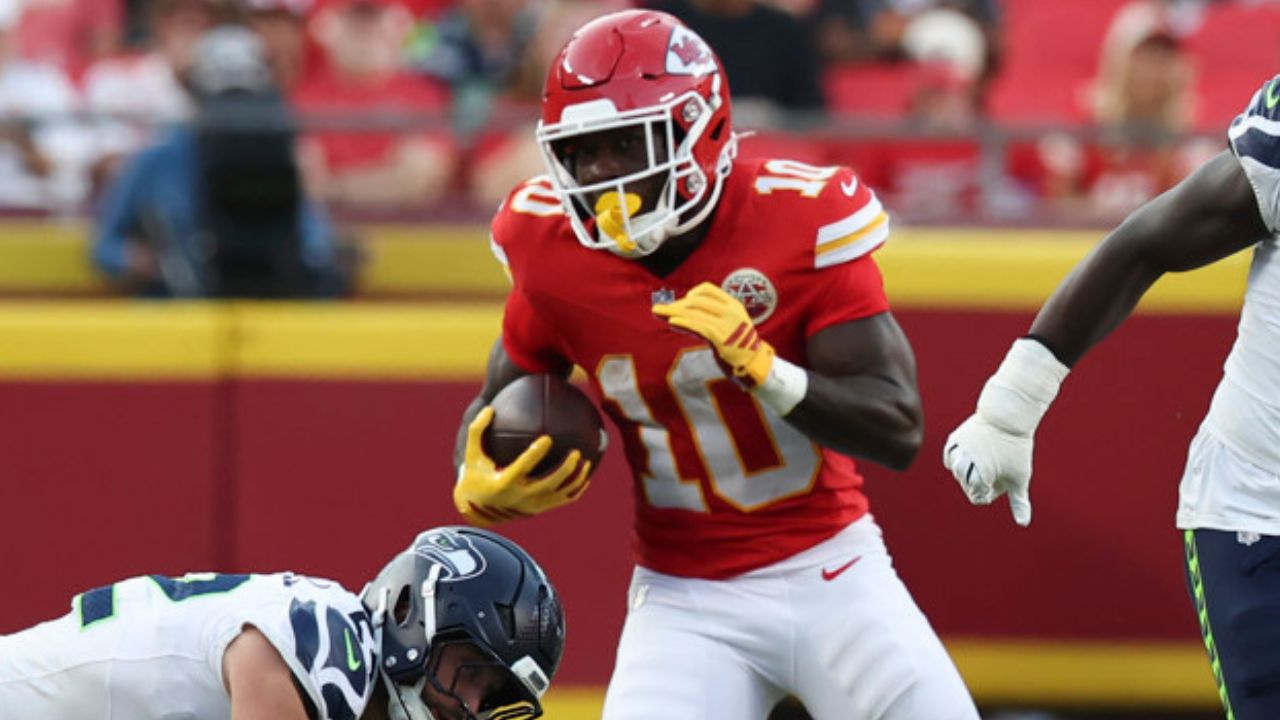
Top 10 Fantasy Football Takeaways from Week 1 Usage

What Week 1 Usage Really Told Us
Box scores lie. Usage tells the truth.
We dug into the playing time, routes, carries, and targets behind the fantasy points to identify the biggest buy-low opportunities, sell-high candidates, and rankings movers heading into Week 2.
Here are the 10 biggest fantasy takeaways from Week 1 usage.
1. What’s the Panic Level on Christian McCaffrey?
| Christian McCaffrey | Kaelon Black | |
| Snap Rate | 55% | 44% |
| Route Rate | 58% | 33% |
| Carry Share | 33.0% | 46.7% |
| Target Share | 23.5% | 2.9% |
Black out-carrying McCaffrey 14-10 was the biggest surprise of Week 1.
It was clearly San Francisco’s plan coming in. Black hit the field on the very first drive, carrying twice, and finished the first half with 7 carries to McCaffrey’s 3.
That marked a huge shift from last year, when CMC handled 64.7% of 49ers carries.
Do I expect this to continue going forward? Kinda.
There are a couple of important caveats to note with this Week 1 usage:

- McCaffrey missed a couple of weeks of training camp.
- This game was played in freakin’ Australia.
Those are both good reasons to scale back McCaffrey’s workload for one game.
But there are also reasons to believe that Black will remain significantly involved. McCaffrey is 30, coming off a huge workload, and was less effective as a runner last year.
Most importantly, the 49ers’ plan worked. They ran for 174 yards on 5.8 per carry against a good Rams defense.
I’m ultimately expecting McCaffrey’s rushing share to settle somewhere between last year’s and what we saw in Week 1. But it’s a situation to track closely in Week 2.
Of course, McCaffrey remained a huge part of San Francisco’s passing game, finishing third among all Week 1 RBs in target share and second in targets (8). That landed him 14th in expected PPR points.
Fantasy Impact
The path to an overall RB1 finish might be gone if this work share holds, but McCaffrey still looks like at least a top-8 RB. And his odds of staying healthy improve with fewer snaps and touches. Black isn’t a fantasy starter yet, but he could turn into one by the time bye weeks hit. And he’s locked in as a high-end handcuff.
2. Ashton Jeanty’s Injury Feels Like a Decade Ago
| Ashton Jeanty | Mike Washington | Dylan Laube | |
| Snap Rate | 73% | 19% | 13% |
| Route Rate | 61% | 10% | 16% |
| Carry Share | 62.2% | 18.9% | 0.0% |
| Target Share | 20.0% | 0.0% | 0.0% |
Remember when we thought Jeanty would miss the start of the season and he was available in Round 3 of fantasy drafts? Good times.
Jeanty was not only ready for the opener. He was ready for a huge role. His 73% snap rate and 61% route rate both ranked fifth among all RBs on the week. His 29 total opportunities (23 carries, 6 targets) tied for third league-wide. And his 22.9 expected PPR points ranked fifth.
It was very similar to Jeanty’s role last year:

- 78% snap share
- 59% route rate
- 72.1% carry share
- 14.2% target share
The difference this year is that the Raiders offense looks more competent. They ranked 20th in EPA per play in Week 1, up from 31st last season. And their 1.35 yards before contact ranked 22nd, up from 1.06 and dead last in 2025.
The matchups will get tougher than Miami. Vegas still doesn’t project to be playing with the lead very often. But Jeanty’s passing-game role insulates him from negative game script.
Fantasy Impact
Jeanty's Week 1 usage makes him a lock for RB1 production with upside into the top 5. If you drafted him anywhere outside Round 1, you did very well.
3. What’s Jadarian Price’s Role Worth?
| Jadarian Price | George Holani | Emanuel Wilson | |
| Snap Rate | 48% | 46% | 6% |
| Route Rate | 43% | 25% | 0% |
| Carry Share | 45.5% | 36.4% | 9.1% |
| Target Share | 8.3% | 4.2% | 0.0% |
Price’s Week 1 role was exactly what I expected based on all the reporting out of Seattle this summer.
He controlled early-down work, playing 66% of those snaps. But he ceded all 10 third-down snaps to Holani. Wilson got involved in short-yardage situations, taking two of those snaps to Holani’s two and Price’s one.
It was comparable to Ken Walker’s role last year. In 16 games with Zach Charbonnet, Walker:
- Played 45.9% of the offensive snaps
- Ran a route on 31.9% of pass plays
- Handled 43.2% of the carries
- Drew a 7.2% target share
That role made Walker the RB32 in PPR points per game and RB36 in expected PPR points per game.
That’s a good gauge of Price’s current value. He’s a RB3 who figures to produce better with positive game script.
But it’s also possible that the rookie’s role grows, at least until Zach Charbonnet is ready to return from his knee injury. Price was clearly Seattle’s best runner in the opener, averaging 5.2 yards per carry and 3.0 yards after contact per carry, according Pro Football Focus. Holani and Wilson combined for just 3.2 yards per carry and 1.9 yards after contact per carry.
Fantasy Impact
Treat Price as a RB3 for now, but don’t be surprised if he climbs into RB2 territory. He could be a nice trade target this week after a disappointing Week 1 box score.
4. The Truth About Houston’s Backfield
| David Montgomery | Woody Marks | |
| Snap Rate | 49% | 51% |
| Route Rate | 33% | 33% |
| Carry Share | 62.5% | 28.1% |
| Target Share | 7.9% | 2.6% |
The fantasy box score says Montgomery is the man in Houston’s backfield. He exploded for 28.9 PPR points in the Week 1 loss to the Bills, while Marks mustered just 5.0.
Three TDs will do that for you.
The reality is that Montgomery and Marks split snaps down the middle. Montgomery handled more early-down work, but Marks played more on passing downs and took all the 2-minute snaps.
The key edge for Montgomery came near the end zone. He out-carried Marks 4-0 inside the 10-yard line and 3-0 inside the 5.
That makes Montgomery clearly the better fantasy bet going forward. But the gap isn’t nearly as big as the Week 1 production suggests.
Fantasy Impact
Montgomery looks like a fine RB2 going forward. But his value might be at its peak right now. If you have some depth at RB, consider shopping Montgomery this week.
5. Colston Loveland is the Easiest Buy Low in Fantasy Football History
| Colston Loveland | |
| Snap Rate | 87% |
| Route Rate | 89% |
| Target Share | 6.9% |
The Bears scored 59 points in Week 1. Loveland scored 0.
I didn’t think that was possible. But it gives us one last chance to get our hands on a guy who I still believe will post big fantasy numbers this season.
Loveland’s playing time was elite in the opener. In fact, his 89% route rate led all TEs in Week 1. For perspective, he ran a route on 80% of pass plays in his monster five-game stretch to close last season, when he averaged 16.8 PPR points per game.
Give Loveland last year’s 0.22 targets per route on the 34 routes he ran vs. Carolina, and he comes away with 7.6 targets.
The ball simply didn’t go Loveland’s way in Week 1. And when it did, QB Caleb Williams made his worst throw in an otherwise excellent game.
Colston Loveland getting wide open from the slot on an over route. Ball just misses him. pic.twitter.com/Lzz3nM6qgn
— Max Toscano (@maxtoscano1) September 15, 2026
Chicago’s offense looked unstoppable, the defense was pathetic, and Loveland’s playing time was awesome.
Fantasy Impact
Buy! Buy! Buy! Despite the Week 1 goose egg, I’m just as confident now as I was a week ago that Loveland is in line for a big season. See if his owner is panicking and willing to let him go this week.
6. Dave Canales Sticks With a Feature Back (And It’s Chuba Hubbard)
| Chuba Hubbard | Jonathon Brooks | A.J. Dillon | |
| Snap Rate | 69% | 19% | 11% |
| Route Rate | 58% | 12% | 5% |
| Carry Share | 45.5% | 18.2% | 22.7% |
| Target Share | 7.9% | 5.3% | 0.0% |
Canales has leaned on a clear feature back throughout his play-calling career. That continued in the 2026 opener.
Hubbard dominated work on early downs, passing downs, and near the goal line. Brooks was a lightly used change-of-pace back.
Hubbard’s usage looked even better before he ceded garbage-time work to Dillon in the fourth quarter. Through three quarters, Hubbard:
- Played 77% of the snaps
- Ran a route on 63% of pass plays
- Handled 71% of the carries
All three of those marks would have ranked top-10 among RBs on the week.
This is nothing new for Canales’ backfield. He spurred Rachaad White to a breakout RB10 finish in 2023 and helped Hubbard finish RB13 in 2024. Even last year, Hubbard was RB17 through Week 4 before Rico Dowdle took over and ranked 12th at the position from Week 5 on.
Fantasy Impact
It’s a long season, and Brooks could still make a run at the lead job. But, for now, Hubbard looks like a solid weekly RB2 in fantasy lineups.
7. Travis Etienne is an Expensive Committee Back
| Travis Etienne | Kendre Miller | C.J. Donaldson | |
| Snap Rate | 58% | 30% | 16% |
| Route Rate | 38% | 8% | 11% |
| Carry Share | 36.0% | 36.0% | 8.0% |
| Target Share | 16.1% | 0.0% | 3.6% |
The Saints paid Etienne $48 million in free agency and promptly used him in a 3-RB committee in Week 1, alongside Kendre Miller and ... (*checks notes*) ... C.J. Donaldson.
Etienne led the backfield in snaps but was matched in carries (9) by Miller. He also lost six third-down snaps and three 2-minute snaps to Donaldson, an undrafted rookie who totaled 47 catches across four college seasons.
Etienne came away from Week 1 with 14.9 PPR points. But that was largely due to the Saints running 86 plays -- nearly 1.5 games' worth -- in the overtime loss.
Etienne averaged 5.1 yards per carry across his 9 attempts, which could earn him more carries going forward. But he’ll also need to contend with the impending return of RB Alvin Kamara, who will particularly threaten passing situations.
Fantasy Impact
It was an alarming debut for Etienne. I'm not totally buying it as a trend moving forward because of that contract. But consider Etienne just a low-end RB2 for now.
8. Wheels Up for Dalton Kincaid
| Dalton Kincaid | |
| Snap Rate | 72% |
| Route Rate | 69% |
| Target Share | 20.7% |
Here’s what I wrote on Kincaid in this summer’s League Winners article:
He posted a 68.3% route rate as a rookie in 2023 and 57.7% in 2024.
If he maintained last year's 0.70 PPR points per route on his 2024 route volume (19.5 routes per game), he'd average 13.7 PPR points per game. That would have ranked TE5 last season.
Getting back to his rookie usage would be even more exciting.
Applying that same efficiency to his 2023 workload (26.4 routes per game) yields 18.5 PPR points per game. That would have ranked TE2, just 0.1 points per game behind Trey McBride.
That's obviously an aggressive projection, but it gives you a taste of the upside Kincaid possesses.

Maybe that projection wasn’t so aggressive.
Kincaid’s 69% route rate in the opener lined up with his rookie-year usage. He didn’t reach a 69% route rate a single time last season.
Kincaid also looked awesome on his way to 130 yards against a tough Texans defense. He lined up all over the formation: 19 snaps inline, 16 in the slot, six out wide, and one in the backfield. And he registered a 15.7-yard average target depth. Kincaid’s 94 air yards led all TEs in Week 1.
This was the type of usage I was dreaming of as I relentlessly hyped up Kincaid all offseason.
Fantasy Impact
Buy the breakout. Kincaid already sits well inside the top 10 TEs in our Week 2 rankings and has upside into the top 5 at his position.
9. Who’s the No. 1 WR in Carolina?
| Jalen Coker | Tetairoa McMillan | |
| Route Rate | 81% | 91% |
| Target Share | 23.7% | 21.1% |
| First-Read Targets | 6 | 6 |
| Air Yards | 127 | 117 |
For at least one week, the answer to that question was Coker.
One-game samples are extremely noisy. But Coker’s run of nice production extends back to the final third of last season. Over his last seven games, he’s averaged:
- 6.4 targets
- 5.1 catches
- 73.7 yards
- 0.86 TDs
That’s 17.6 PPR points per game, which would have ranked sixth among WRs last year. McMillan has averaged 5.9 targets and 10.7 PPR points per game over that same span.
The long view still favors McMillan as Carolina’s top WR. He was an excellent prospect, went eighth overall in the 2025 draft, and had a strong rookie season.
But the longer this Coker run lasts, the more seriously we need to take him as a threat to McMillan’s spot atop the totem pole.
Fantasy Impact
The Panthers won’t play the Bears every week, and I still have my doubts about QB Bryce Young’s ability to support two fantasy starters at WR. But Coker has at least earned WR4 status and could finish the season inside the top 36. McMillan remains a low-end WR2 for now but could sink to WR3 territory.
10. Good News/Bad News For Cam Skattebo
| Cam Skattebo | Devin Singletary | Tyrone Tracy | |
| Snap Rate | 61% | 37% | 3% |
| Route Rate | 38% | 50% | 0% |
| Carry Share | 48.6% | 16.2% | 5.4% |
| Target Share | 0.0% | 13.8% | 0.0% |
Skattebo dominated early-down snaps, carry share, and goal-line work in the opener. He played 66% of the early-down snaps, per Pro Football Focus, and all nine of the short-yardage/goal-line snaps. Skattebo got two carries from inside the Dallas 5-yard line and scored a 3-yard TD.
That’s the good news.
The bad news is that he lost passing-down work to Singletary, who played five of seven third-down snaps and all six of the 2-minute snaps. Singletary garnered all 4 of the Giants’ RB targets.
Pass-catching production was a big part of the Skattebo bull case. In his six-game stretch as lead back last year, he posted a 54% route rate and a 14.5% target share.
The usage didn’t hurt in Week 1, when the Giants played with the lead throughout. But it’d be damaging in games where the Giants trail.
This backfield still feels fluid. Tracy lost a fumble on a second-quarter carry and didn’t touch the ball again. He might be banished to the shadow realm. But the Giants still have Najee Harris, who is a reliable pass protector and could take passing-down snaps.
Fantasy Impact
Skattebo’s rushing volume and goal-line role keep him inside RB2 territory for now. But he’ll need to earn more passing-down work if he wants a chance to crack the top 15.